Welcome to Electric-Bikes.com
What transportation experts "know" about Personal Rapid Transit
1) A Personal Rapid Transit (PRT) system was built in Morgantown, WV, in the early 70's.
2) PRT is expensive to build.
3) PRT breaks down frequently.
4) Because no other PRT system has been built, PRT won't work for us.What transportation experts "know" is wrong.
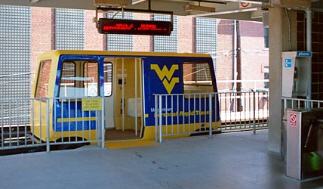
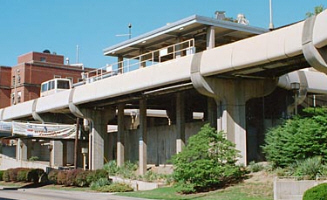
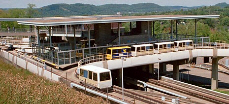
1) A Group Rapid Transit (GRT) system was built in Morgantown.
2) Compared to LRT, PRT costs 1/3 to build, operate, and maintain.
3) Since 1979, the Morgantown GRT system has been in continuous service with a 99% reliability factor.
4) Although special interest groups and transportation "experts" have successfully derailed PRT efforts in many cities, PRT makes economic, environmental, social justice, and service sense for Santa Clara County residents.
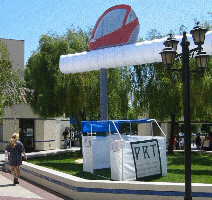
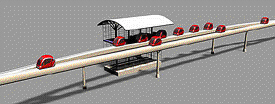
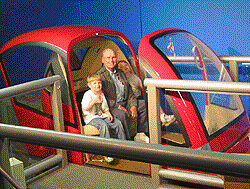
PRT (SkyWeb Express)
Morgantown GRT
Vehicle capacity = 3 seated
Vehicle capacity = 21 (8 seated, 13 standing)
Vehicle Weight (empty) = 1,100 pounds
Vehicle Weight (empty) = 8,760 pounds
Average operating cost per passenger = $0.15
Average operating cost per passenger = $1.27
Find a good overview article about the Morgantown GRT at
http://www.progressiveengineer.com/PEWebBackissues2002/PEWeb%2024%20Mar%2002-2/PRT.htmLink to Further Information and Status of PRT Projects.
www.electric-bikes.com/prt-info.html
Brief analysis of the Morgantown GRT effort
Opponents (specifically LRT manufacturer) drag Morgantown into their discussion, again seeming to hope to convince the reader that a system contracted 34 years ago is the best we can do now. The Morgantown contract was let in December 1970 with the stipulation that the system be operational 22 months later - in October 1972 in time to reelect President Nixon. Here are a few of the problems that ensued:
1. Because of the rush, the fixed-facility builder F. R. Harris of Stamford, Connecticut, was told to assume in their calculations that the vehicles would weight as much as a conventional rapid-rail car, which accounted for the heavy guideway and stations.
2. Eight months into the program, the designated system manager, Jet Propulsion Laboratory of Pasadena, California, resigned from the program because they found that UMTA was using them only for a money pass-through. They were given no budget for systems engineering. Boeing took over as system manager with now only 14 months until the system had to be operational.
3. After Boeing had designed the vehicle, they found that F. R. Harris had designed curves - too late to change - so sharp that their vehicle couldn't negotiate them. In midstream they had to redesign to include back-wheel in addition to front-wheel steering.
4. UMTA told F. R. Harris that they had budgeted for borings at only about one post in five. F. R. Harris insisted that given the mountainous soil conditions in Morgantown they had to test the soil at every post. A big fight ensued, which was resolved only by UMTA giving F. R. Harris a memo taking responsibility for the consequences of the lack of borings. The foundations and columns were built, following which a number of them sagged. So at great expense the team had to dig them out, do the borings, design properly, and reconstruct.
5. In mid program, the team discovered that it snowed in Morgantown and that operating on a slippery guideway was not safe. So they laid pipes in the running surface to carry heated ethylene glycol. Much later, a student of mine who worked at Boeing on automated guideway systems showed me data indicating that on an annual basis it took four times as much energy to melt snow as it did to propel the vehicles.
Notwithstanding all of this and more, they actually ran a vehicle in October 1972. It stopped due to a sensor failure with Teresa Nixon in it, and of course that and the cost over-runs created great press. Over the next few years, the bugs were worked out and the system has been in daily operation ever since - with virtually no press. A few years ago Boeing rebuilt the control system. A visit to Morgantown and a ride on the system in 1989 convince the Chicago RTA leadership that PRT would work and that a much lower cost design could be built provided that the vehicles were kept as small and as light in weight as possible, and that the guideway would not be over designed as happened in Morgantown.
As a basis for the Morgantown system, UMTA select the Alden Starrcar of Bedford, Massachusetts. They had designed a six-passenger vehicle and their cost estimates were based on that. The UMTA leadership increased the size to 20 passengers with eight seats. With the increase in size and all of the problems mentioned above, the cost skyrocketed. Now AA would like you, dear reader, to believe that this is the best that can be done 34 years later!
The effect of the Morgantown project on Congress was to cause them to lose interest in the PRT concept, and this held back PRT development for at least 15 years. Development of PRT has required understanding and cooperation among entities such as cities or high-use developments, investors, and suppliers. With interest in Congress dropped and the federal government telling cities not to look at any non-proven technology, it was much more of a challenge to get all of these people to together, and this is the major answer to the common question: "Why has it taken so long?"
Link to Further Information and Status of PRT Projects.
www.electric-bikes.com/prt-info.html